


Foreword
LTF Design & Marketing works exclusively across pharma, med-tech, aesthetics and dental: sectors where clinical excellence and commercial growth are supposed to move together, but too often don’t.
This white paper is built on 261 completed digital marketing assessments submitted by UK medical aesthetic clinics through the ScoreApp platform, each covering up to 130 questions across SEO, website performance, social media, content, booking systems, email and paid advertising. We are publishing the findings in full, including the uncomfortable ones, because the aesthetics sector doesn’t have a shortage of treatment innovation. It has a shortage of digital fundamentals.
Every clinic in this study offers something a patient wants. Most are simply invisible, slow, or silent at the exact moment that the patient goes looking. This paper sets out what the data shows, what it means for clinics and the med-tech suppliers who depend on their success, and where the fastest, highest-leverage fixes are.
Rick O’Neill, Founder, LTF Design & Marketing Ltd
Executive Summary
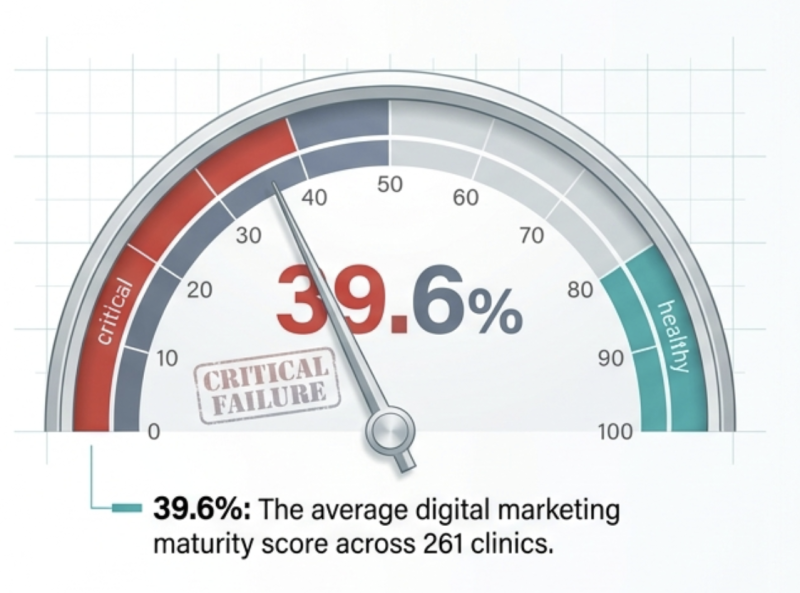
Across 261 UK medical aesthetic clinics assessed in this study, the average digital marketing maturity score was 39.6 out of 100. Not one clinic scored above 64%. Only three, 1.1% of the sample, cleared 60%. This is not a story about a handful of laggards dragging down a strong average. It is the average.
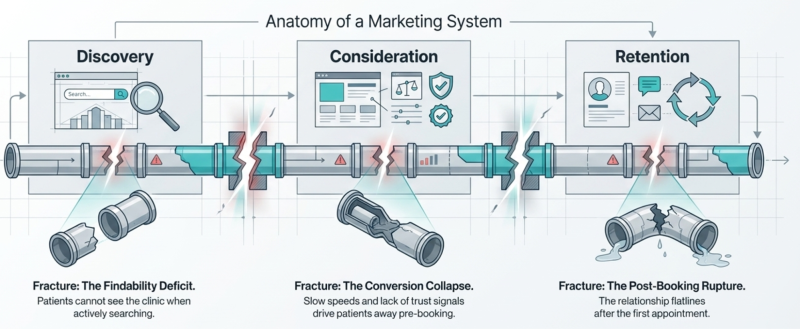
The pattern repeats across every category measured: clinics have built presence (a website, a Google listing, an Instagram account, a booking system) but rarely finish the work that turns presence into performance. Mobile websites load too slowly to hold attention. A third of clinics don’t appear in the map results for their own best treatment, in their own town. Patient email lists sit fully consented and entirely dormant. Paid advertising, the channel best suited to fast, trackable growth, is the weakest-performing category in the entire study.
The clinics at the top of this dataset are not spending significantly more than the ones at the bottom. The gap between the top and bottom quartile is overwhelmingly a gap in follow-through: publishing consistently, tracking what’s sent, automating what’s promised. That is the central, genuinely useful finding of this report: the fixes are largely operational, not financial, and most are within reach in weeks, not years.
For the device manufacturers, product suppliers and training providers who sell into this sector, the implication is direct: clinics’ ability to convert marketing spend and device investment into booked, repeat patients is capped by weak digital infrastructure. A clinic that can’t be found, loads too slowly to hold a visitor, and never re-engages its own patient list will underperform on utilisation and repeat-treatment revenue regardless of how good the technology or protocol behind the treatment chair is. Digital maturity is now a commercial multiplier on clinical and product investment, and, per this data, one the sector has not yet built.
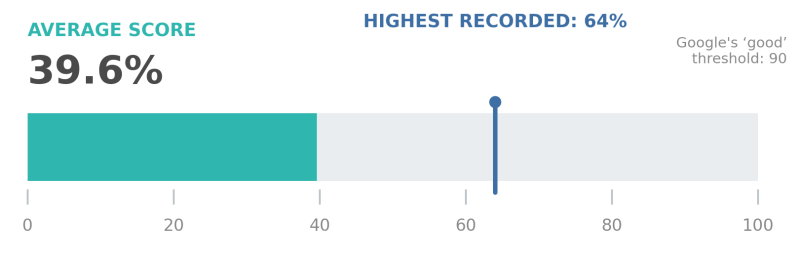
Overall Score across 261 clinics: average, and the highest score any single clinic achieved.
Methodology
This report is based on 261 completed digital marketing self-assessments submitted by medical aesthetic clinics, predominantly UK-based, through the ScoreApp platform. Each clinic answered up to 130 questions covering Google and SEO, social media, website design and performance, content marketing, booking and patient onboarding systems, email marketing, and paid advertising. Every clinic received a weighted score out of 100 overall, and a score for each of eight categories. Fifteen incomplete submissions and internal test entries were excluded from this analysis.
One methodological point matters for how the headline “Overall Score” should be read: Website Performance (page load speed) carries roughly 55 to 60% of the total points available, far more than any other category. This is a deliberate design choice: page speed correlates more strongly with Overall Score (r = 0.87) than any other single factor, but it means the Overall Score is best understood as a proxy weighted heavily toward technical performance, not a simple average across all disciplines. The category-level scores used throughout this paper give the fuller picture.
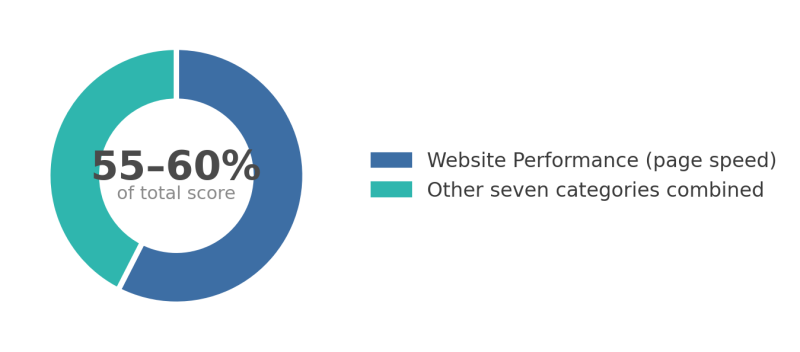 Approximate share of the Overall Score determined by Website Performance alone.
Part One: Ten Insights Into the State of the Industry
The ten findings below are the headline patterns most likely to matter to anyone operating, investing in, or supplying into the aesthetics sector, each grounded directly in the dataset.
1. No clinic in the study is doing digital marketing well
Average score: 39.6% | Highest recorded: 64% | Scoring 60%+: 1.1%
Across 261 assessments, not a single clinic scored above 64% overall, and only three clinics (1.1%) crossed the 60% mark. The average clinic scores just 39.6%, and 42.9% score below 40%. In a sector built on visual proof and patient trust, the digital fundamentals (findability, speed, conversion, follow-up) are still largely unbuilt. Even the best-performing clinics in the sample are, at most, two-thirds of the way to marketing best practice.
THE LTF VIEW
We see this pattern in almost every audit we run in this sector: individual channels look reasonable in isolation, but no clinic has joined them into a system. A ceiling of 64% is not a technology ceiling; it is evidence that even the most capable operators haven’t yet been shown what “complete” looks like.
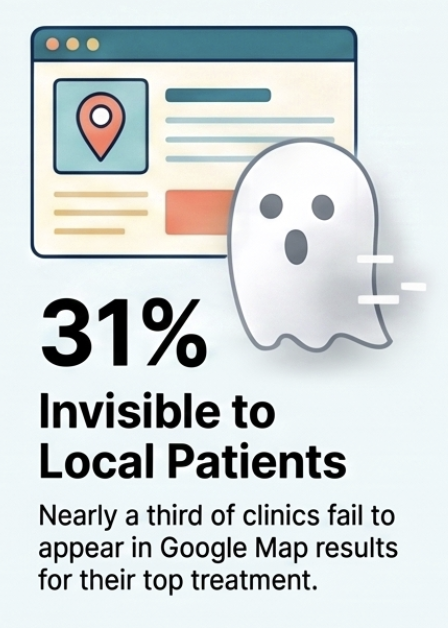
2. A third of clinics are invisible for their own best treatment, in their own town
31.4% do not rank in the top 10 map results for their #1 treatment + town
When clinics searched Google for their top treatment plus their town, arguably the single highest-intent search a prospective patient can make, 31.4% did not appear anywhere in the top 10 Google Map results, and only 19.9% ranked #1. For a local-service business where “near me” search intent drives bookings, this represents a direct, quantifiable loss of patients to competitors who do appear.
THE LTF VIEW
Local map visibility is one of the fastest-moving levers we work on with new clients, typically inside four to six weeks, because it depends on completeness and consistency rather than budget. A clinic losing this search is losing patients who have already decided to buy: the most expensive kind of lead to lose.
3. Page speed is quietly deciding who wins, and almost everyone is losing
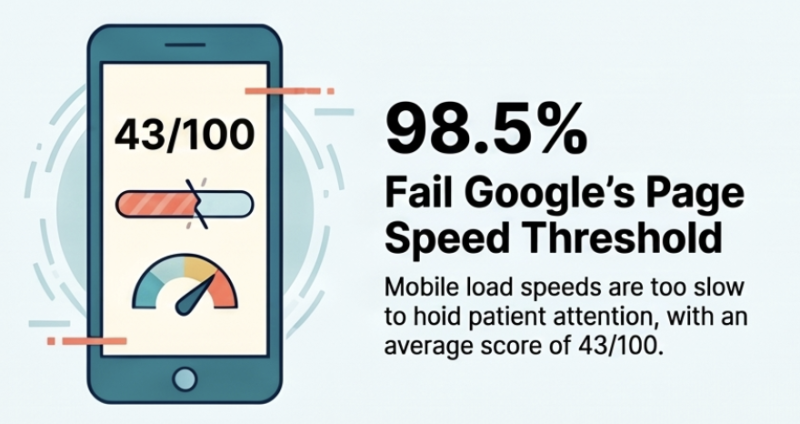
Average mobile PageSpeed: 43/100 | Below Google’s “good” threshold (90): 98.5%
Average mobile PageSpeed score across the sample is 43 out of 100; 65.1% of clinics score below 50, and 98.5% fall short of Google’s own “good” threshold of 90. Website Performance correlates far more strongly with Overall Score (r = 0.87) than any other category, reflecting both its outsized weighting and its outsized real-world effect on bounce rates and conversion. Slow, clunky mobile sites are the single biggest lever clinics aren’t pulling.
THE LTF VIEW
This is the single highest-leverage technical fix in the dataset. A 0.87 correlation means speed isn’t a nice-to-have alongside good marketing; for most clinics in this sample, it effectively is the marketing. We treat a PageSpeed audit as step one of any new engagement for exactly this reason.
4. The gap between top and bottom performers isn’t budget: it’s follow-through on basics
Largest top-vs-bottom quartile gap: regular blog publishing (+49 points)
Comparing top-quartile and bottom-quartile clinics by Overall Score reveals the widest behavioural gaps aren’t exotic tactics but simple consistency: publishing blog content regularly (63.0% of top performers vs 13.6% of bottom performers, a 49-point gap), a mapped and automated onboarding journey (50.7% vs 9.1%, a 42-point gap), and tracking email performance (68.5% vs 25.8%, a 43-point gap). High performers aren’t spending more; they are finishing the fundamentals that low performers start and abandon.
THE LTF VIEW
This finding is why our engagement model is built around cadence, not campaigns. A monthly content calendar and a tracked, automated email programme, run consistently, will outperform an occasional burst of paid spend nearly every time in this sector.
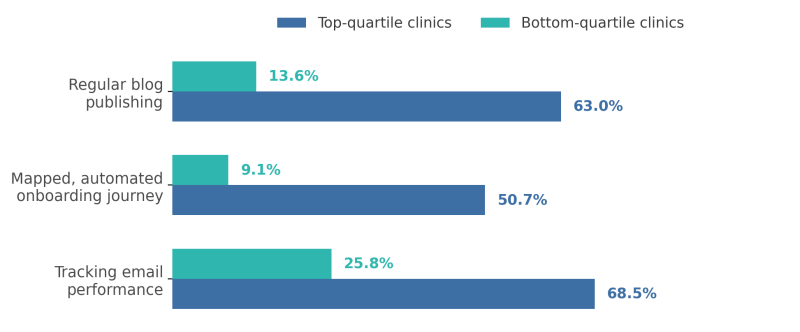
Top-quartile vs bottom-quartile clinics on three follow-through behaviours.
5. Paid advertising is the weakest category in the entire assessment, and most clinics avoid it altogether
Digital Advertising average score: 26.9% (lowest of 8 categories) | Running any paid ads: 34.9%
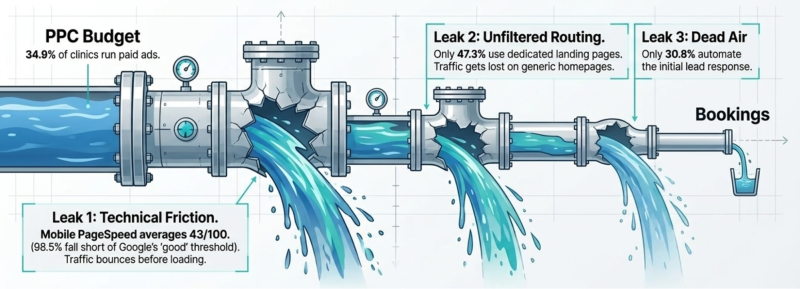
Digital Advertising is the lowest-scoring of all eight categories (26.9% average, 13% median: half of all clinics score at or near the floor). Only 34.9% of clinics run any paid ads at all. Among those who do, fewer than half (47.3%) have built a dedicated landing page for ad traffic, and just 30.8% automate the initial response to a lead. The category with the highest potential for fast, trackable patient acquisition is the one clinics engage with least, and execute worst.
THE LTF VIEW
Paid media performs worst here for a structural reason: clinics turn ads on without the landing pages or response automation that make them convert. We won’t recommend increasing a client’s ad spend until that foundation is in place; anything else is paying to leak leads.
6. Clinics are buying visibility (followers) but not engagement (reach)
62.8% of clinics: average post reach < follower count bracket
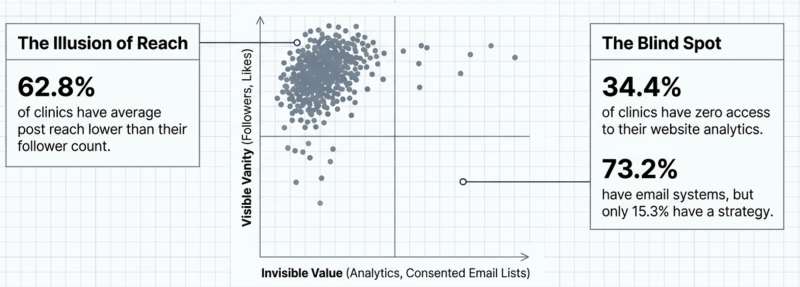
62.8% of clinics have an average Instagram post “Reach” that falls into a lower bracket than their follower count bracket, meaning most posts are seen by a smaller pool of people than the clinic’s total following. Vanity metrics, which clinics can see at a glance, are diverging from the metric that actually predicts patient acquisition. Only 37.2% have a dedicated person designing and publishing content, and only 41.4% schedule content in advance.
THE LTF VIEW
Reach, not follower count, is the metric we report to clients for exactly this reason: it’s the one that predicts bookings. A consistent, planned content calendar, batch-produced monthly, closes this gap faster than any single viral post would.
7. Clinics are collecting patient data they aren’t using
73.2% have an email system, but only 38.7% send regular content and 15.3% have a strategy
88.5% of clinics claim explicit GDPR consent from patients on their mailing list, and 73.2% have an email marketing system in place, yet only 38.7% actually send regular email content, and just 15.3% have an email strategy for the next 12 months, the single lowest planning metric in the entire survey. Clinics are amassing consented, ready-to-use patient databases and leaving them dormant: a compliance-covered but commercially wasted asset.
THE LTF VIEW
A consented, dormant patient list is close to free revenue left unclaimed. One automated welcome sequence and one monthly newsletter routinely outperform ad-hoc social posting for repeat-treatment revenue, and cost a fraction as much to run.
8. Revenue and email sophistication move together more than any other category
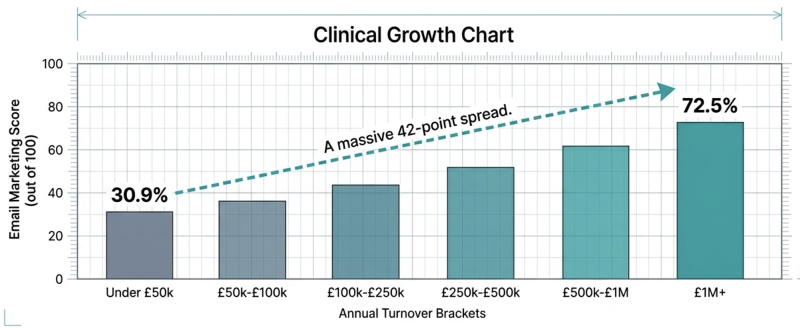
Email Marketing Score: 30.9% (sub-£50k clinics) vs 72.5% (£1M+ clinics)
Email Marketing Score rises from 30.9% among clinics turning over under £50k to 72.5% among clinics turning over £1M+, a 42-point spread and the largest turnover-linked gap of any category, compared with a 12-point spread in Overall Score across the same range. This suggests email maturity is either a leading indicator of scale, or a genuine growth lever that smaller clinics are systematically under-using relative to their larger peers.
THE LTF VIEW
Correlation isn’t causation, but a 42-point spread is large enough to take seriously as a growth lever, not just a symptom of size. This is one of the clearest “do this regardless of scale” findings in the dataset.
9. Half of all clinics with a website have no idea how it’s performing
34.4% of clinics with a website have no analytics access
98.1% of clinics have a website, but 34.4% of those clinics have no access to their own website statistics. Combined with the finding that 57.1% of clinics receive under 500 monthly website visitors, this points to a sector making significant investment in a core marketing asset (the largest single spend band to date is £2,501 to £5,000) while frequently unable to see whether it’s working.
THE LTF VIEW
You cannot improve what you can’t see. Analytics access is a thirty-minute fix at zero cost, and it is the precondition for every other website decision, covering traffic, content and paid, being made on evidence rather than instinct.
10. The booking system is the strongest category, but the patient journey stops at the first appointment
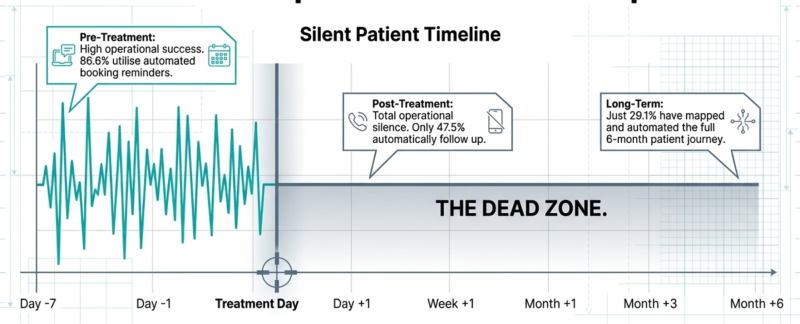
86.6% have automated booking reminders, but only 29.1% automate the full onboarding journey
Booking & On-boarding is the highest-scoring category by far (67.6% average, more than double Digital Advertising). 86.6% of clinics have automated booking reminders and only 10.3% still use a paper diary: genuine modernisation has happened here. But only 47.5% have an automatic follow-up system, and just 29.1% have mapped and automated the complete patient journey from first booking through to six months later. Clinics have solved the transaction; they haven’t solved the relationship.
THE LTF VIEW
Aesthetics is a repeat-purchase, referral-driven category. Automating the six months after a first booking, not just the reminder before it, is usually the single most profitable piece of work we do for an established clinic, because the relationship, not the first appointment, is where the margin sits.
Part Two: Ten Moves That Close the Gap
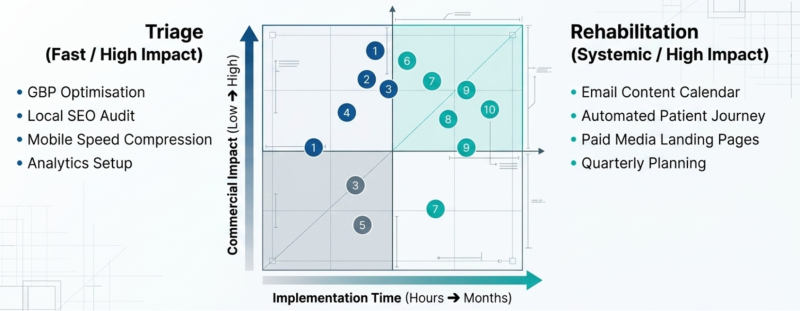
Ranked by a combination of scale (how many clinics are affected) and ease of fix. None of the ten requires a marketing department or a significant budget increase to begin.
1. Unmanaged or incomplete Google Business Profiles
95.4% have a listing, only 84.7% actively manage it | Keyword-rich description: 47.1% | Q&A populated: 18.0%
The gap: Roughly one in six clinics has a Google Business Profile nobody is looking after. Even among those managing it, most haven’t filled in the fields Google itself uses to decide local ranking: descriptions, Q&A, service lists, and offers.
What to do: Assign one team member (or agency) ownership of the GBP listing. In a single sitting: add a 750-character keyword-rich description naming the town and top three treatments, populate five to ten FAQs, list every treatment as a service, and add one live offer. A half-day task, no ad spend required.
THE LTF VIEW
This is the first fix in every audit we run: it’s unpaid, half a day of work, and often the fastest movement in local ranking clients see.
2. Not appearing in local Map Pack results for the highest-intent search a clinic can win
31.4% do not rank in the top 10 map results for “top treatment + town”
The gap: This is the search a patient makes when they’ve already decided to book and are choosing between providers. Not appearing here hands the booking directly to a competitor.
What to do: Run a local SEO audit focused on Map Pack factors specifically: name/address/phone consistency across directories, review velocity and recency, category selection, and proximity-relevant keywords in the business description and title tags. Prioritise the single treatment driving the most revenue first, then expand.
THE LTF VIEW
We run this as a standalone local SEO audit before touching any other channel, because it’s the search closest to an already-decided patient.
3. Mobile websites that are too slow to convert
Average mobile PageSpeed score: 43/100 | 65.1% score below 50
The gap: Slow mobile load times directly increase bounce rate before a prospective patient ever sees before/after photos or pricing, the two things aesthetics patients are actively hunting for.
What to do: Run every clinic website through Google PageSpeed Insights and action the top three flagged issues, typically unoptimised images, render-blocking scripts, and a lack of caching or CDN. Compressing images alone often lifts mobile scores 15 to 20 points with no design change.
THE LTF VIEW
Image compression is usually the single highest-return hour a clinic can spend on its website, and it needs no design change to implement.
4. Dormant email lists sitting on consented, ready-to-use patient data
73.2% have an email system and 88.5% claim consent, but only 38.7% send regular content and 15.3% have a strategy
The gap: This is the highest-leverage, lowest-cost channel in the entire assessment: the list already exists and is already legally usable, and it is the most neglected relative to its potential.
What to do: Build a simple twelve-month content calendar: one monthly newsletter (before/afters, new treatments, seasonal offers) plus one automated welcome sequence for new patients. Start tracking open and click rates immediately, since only 46.7% currently do, so campaigns can be optimised rather than run blind.
THE LTF VIEW
The infrastructure already exists in 73% of this sample. The barrier isn’t a system, it’s a content calendar, which is the part we build first.
5. Paid advertising without landing pages or automated lead response
Among the 34.9% running PPC: only 47.3% have dedicated landing pages, only 30.8% automate the initial response
The gap: Sending paid traffic to a generic homepage, then manually responding to leads hours or days later, wastes a large share of every pound spent on ads before the patient ever reaches the booking stage.
What to do: Before increasing ad spend, build one dedicated landing page per core treatment (no site navigation, one clear call-to-action, testimonials and before/afters above the fold) and connect an automated instant-response tool so no lead waits more than a few minutes for first contact.
THE LTF VIEW
We won’t recommend increasing a client’s ad spend until the landing page and lead-response layer are in place; anything else is paying to leak leads.
6. No visibility into whether the website is actually working
34.4% of clinics with a website have no analytics access | 57.1% report under 500 monthly visitors
The gap: Without analytics, clinics can’t tell whether low enquiry volume is a traffic problem, a conversion problem, or both, so money gets spent on guesswork.
What to do: Install Google Analytics 4 and Google Search Console (free, one-time thirty-minute setup) on every clinic website. At minimum, track monthly visitors, top landing pages, and enquiry form conversion rate so future marketing spend can be pointed at what’s actually underperforming.
THE LTF VIEW
Non-negotiable, day-one setup for every client we onboard: it’s the baseline every other recommendation in this paper depends on.
7. Social media builds an audience but not a following that converts
62.8% have post reach lower than their follower count bracket | Only 37.2% have a dedicated content creator
The gap: Clinics are treating social media as a broadcast channel rather than a managed programme, posting inconsistently, without a content plan, and without measuring what actually reaches people.
What to do: Move to a scheduling tool and a rolling monthly content calendar mixing education (procedure explainers), proof (before/afters, testimonials), and offers. Batch-produce content monthly rather than posting reactively; this alone tends to close much of the reach gap.
THE LTF VIEW
A rolling content calendar, batch-produced monthly, is the fastest way we’ve found to close this gap without adding headcount.
8. The patient journey ends at the first booking
Only 47.5% automatically follow up post-treatment | Only 29.1% have mapped the full 6-month patient journey
The gap: Aesthetic treatments are repeat-purchase and referral-driven by nature, but most clinics have no system nudging a first-time patient toward their second treatment, a review, or a referral.
What to do: Map the patient lifecycle from enquiry to six months post-treatment and automate three touchpoints at minimum: a post-treatment check-in, a review request timed to peak results, and a re-booking prompt for maintenance treatments. Most booking platforms already support this natively; it is frequently a configuration gap, not a technology gap.
THE LTF VIEW
Most booking platforms already support this automation: the gap is usually configuration, not technology, which makes it one of the cheapest high-value fixes on this list.
9. Website conversion tools are largely absent
Live chat: 19.2% | Lead magnet: 16.5% | Comprehensive FAQ: 55.6% | Case studies/before-afters: 49.8%
The gap: Roughly half of clinics don’t display the before/after proof and case studies that are the single biggest trust-builder in aesthetics, and most offer no lower-commitment way for a hesitant visitor to engage before booking a consultation.
What to do: Prioritise in order: add a before/after gallery organised by treatment if one doesn’t exist; add a simple FAQ addressing cost, downtime, and safety objections; add one lead magnet, such as a downloadable treatment guide or price list, gated behind an email address.
THE LTF VIEW
Before/after galleries and a clear FAQ address the two biggest objections aesthetics patients have before they’ll book, cost and safety, and both are content projects, not development projects.
10. No forward plan for content or email: clinics are reactive, not strategic
Content strategy: 19.2% | Email strategy: 15.3% | PPC initial-response automation: 11.9%
The gap: These three numbers are the lowest planning metrics in the entire dataset. Clinics are executing tactically, posting when they remember and emailing when they think of it, rather than working from a documented plan, which makes consistent, compounding results almost impossible.
What to do: Adopt a simple quarterly marketing plan covering content themes, email sends, and campaign calendar. Even a one-page plan reviewed monthly outperforms ad-hoc activity. This is a leadership and process fix, not a technology purchase, and it is the precondition for every other fix in this section actually sticking.
THE LTF VIEW
This is the fix that makes every other fix on this list stick. We build a one-page quarterly plan with every new client for exactly this reason: consistency compounds, ad-hoc doesn’t.
Part Three: The Full Data Set (30 Reference Points)
A comprehensive reference of standalone findings from the dataset, organised by category, for anyone who wants the details behind the headlines.
Overall Performance
- Average Overall Score across 261 clinics is 39.6% (median 40%); no clinic scored above 64%.
- Only 1.1% of clinics (3 of 261) scored 60% or higher overall; 42.9% scored below 40%.
- Overall Score rises with annual turnover, from 35.2% (under £50k) to 47.1% (£1M+): a 12-point spread, moderate correlation (r = 0.31).
- Website Performance Score correlates with Overall Score at r = 0.87, far stronger than any other category.
Google / SEO & Google Business Profile
- 95.4% of clinics have a Google Business Profile, but only 84.7% actively manage it.
- 31.4% do not appear in the top 10 Map Pack results when searching their top treatment + town; only 19.9% rank #1.
- 55.9% never post updates into their Google Business Profile.
- 62.8% always respond to GBP reviews; the remaining 37.2% respond inconsistently or not at all.
- Only 47.1% have added a keyword-rich GBP description, and only 18.0% have populated the Q&A section.
- Only 43.3% have listed all their treatments and services on their GBP profile.
- Only 47.5% have had their website professionally optimised for search (copy and metadata).
- 70.1% of clinics get 50 or fewer monthly “clicks to call” from their Google Business Profile.
Website Design & Performance
- 98.1% of clinics have a website; 95.8% of those are mobile-responsive.
- Average mobile PageSpeed score is 43/100; 65.1% score below 50, and 98.5% fall short of Google’s “good” (90+) threshold.
- Average desktop PageSpeed score is 67/100, markedly better than mobile and pointing to a mobile-specific optimisation gap.
- 34.4% of clinics with a website have no access to their own analytics data.
- 57.1% of clinics receive fewer than 500 monthly website visitors; 33.3% receive 100 or fewer.
- Only 49.8% display case studies or before/after photos on their website, a core trust signal for aesthetics patients.
- Only 19.2% offer live chat and only 16.5% offer a lead magnet, limiting how hesitant visitors can engage pre-booking.
- WordPress is the dominant website platform (64.8% of clinics), followed by Wix (18.0%) and Squarespace (6.5%).
Social Media
- 87.7% of clinics are active on Instagram and 77.4% on Facebook, but only 37.2% have someone dedicated to designing and publishing content.
- 62.8% of clinics see average post reach fall below their follower-count bracket, suggesting engagement is lagging audience size.
- Only 9.2% have a dedicated Facebook Group for patients, and only 14.6% run livestreams.
- 41.4% schedule social content in advance using a scheduling tool; the majority still post reactively.
Content, Booking & Email
- Only 19.2% of clinics have a documented content strategy for the next 12 months, the lowest planning metric alongside email strategy.
- Booking & On-boarding is the strongest category overall (67.6% average); 86.6% have automated booking reminders and only 10.3% still use a paper diary.
- Despite strong booking automation, only 29.1% have mapped and automated the complete patient journey through to six months post-booking.
- 73.2% have an email marketing system, but only 38.7% send regular content and just 15.3% have a forward strategy.
- Email Marketing Score shows the steepest turnover-linked gradient of any category: 30.9% for sub-£50k clinics vs 72.5% for £1M+ clinics.
Paid Advertising
- Digital Advertising is the lowest-scoring category overall (26.9% average, 13% median) and only 34.9% of clinics run any paid ads at all.
- Among clinics running paid ads, just 47.3% use dedicated landing pages and 30.8% automate lead response: the fundamentals that make paid spend efficient are the exception, not the norm.
At a Glance
| Metric | Value |
| Clinics assessed | 261 |
| Average Overall Score | 39.6% |
| Median Overall Score | 40% |
| Highest score recorded | 64% |
| Clinics scoring 60%+ | 1.1% (3 clinics) |
| Clinics scoring below 40% | 42.9% |
| Weakest category | Digital Advertising (26.9%) |
| Strongest category | Booking & On-boarding (67.6%) |
Where LTF Fits
We built this benchmark because we wanted a genuine, sector-wide baseline before we tell any client where they stand against it, not a sales pitch dressed as research. Every fix in this paper is one we implement with clients across pharma, med-tech, aesthetics and dental, and none of them start with “spend more.”
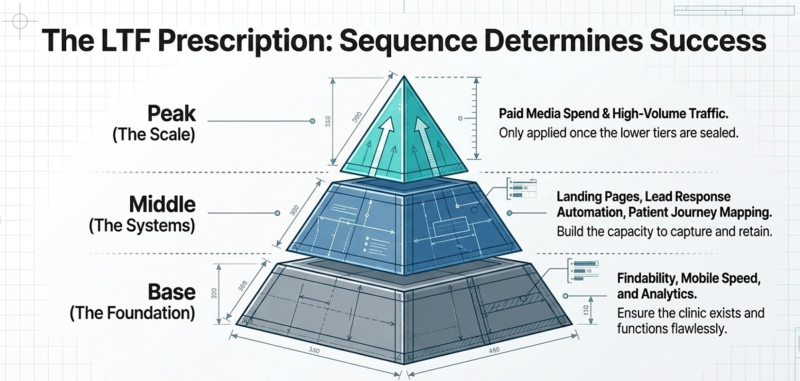
Our approach is fundamentals-first: fix findability, speed and analytics before scaling content; fix landing pages and lead response before scaling ad spend; automate the patient journey before chasing new leads to fill it. It is a deliberately unglamorous sequence, and it is also, per this dataset, the one that separates the top quartile from everyone else.
Benchmark Your Own Clinic or Brand
If you’d like to see how your clinic, group, or product marketing benchmarks against this dataset, we run a free digital marketing assessment using the same framework behind this report.
Get in touch: email us: Us@ltf.email or visit: ltf.digital
About LTF Design & Marketing Ltd
LTF Design & Marketing Ltd is a marketing and growth agency working exclusively across pharma, med-tech, aesthetics and dental. We combine data-led strategy with in-house creative and channel execution to help clinics, product suppliers and healthcare brands turn clinical excellence into commercial growth.
© 2026 LTF Design & Marketing Ltd. Data drawn from 261 completed ScoreApp digital marketing assessments of UK medical aesthetic clinics, July 2026.
